

From Fragmented to Court-Ready
Today
- Scattered spreadsheets and photos
- Manual reconciliation before every filing
- No record of who changed what
- Inconsistent formats across cases
With Dossery
- Each asset captured with structured data and linked evidence
- Records sealed at creation with verified identity
- Every action logged with timestamp and attribution
- Outputs generated in formats aligned with filing requirements
How It Works
Capture
Asset details are recorded at the source by the client, executor, or fiduciary. Each record includes high-resolution photos, written descriptions, condition notes, location, ownership context, and supporting documents such as receipts, certificates of authenticity, or prior appraisals. Guided input fields ensure completeness and consistency across all records.
Seal
Each record is sealed automatically at the point of creation. The sealed state is permanently preserved and independently verifiable. Any post-creation modification is immediately detectable, establishing a tamper-evident baseline that persists through the entire record lifecycle.
Track
Every action on every record is logged: creation, updates, access events, sharing, and export. Each log entry includes a timestamp and verified user identity. The result is a continuous, auditable history from first entry through final disposition that supports fiduciary accountability.
Output
Structured inventories and reports are generated directly from recorded asset data. Outputs include standardized asset listings with linked evidence, valuation references, condition documentation, and a complete audit trail. Reports are designed to support jurisdiction-specific formatting requirements as the platform expands. No manual reconciliation or reformatting is required.
Why These Records Support Legal Review
- Records are created before disputes arise
- Chain of custody is continuous from capture through legal use
- Evidence is attached at the source, not reconstructed later
- Outputs align with court and probate expectations
- Every action is tied to a verified user with a timestamp
Defensibility is determined by how records are created, not when they are needed.
What You Receive
Asset Inventory
Complete, standardized asset records with images and linked evidence.
Court-Ready Reports
Formatted for probate filings and aligned with jurisdictional requirements.
Audit Trail
Full record of every action, change, and access event.
Example Output
Outputs Designed for Legal Use
Court-ready inventories are generated directly from structured asset records.
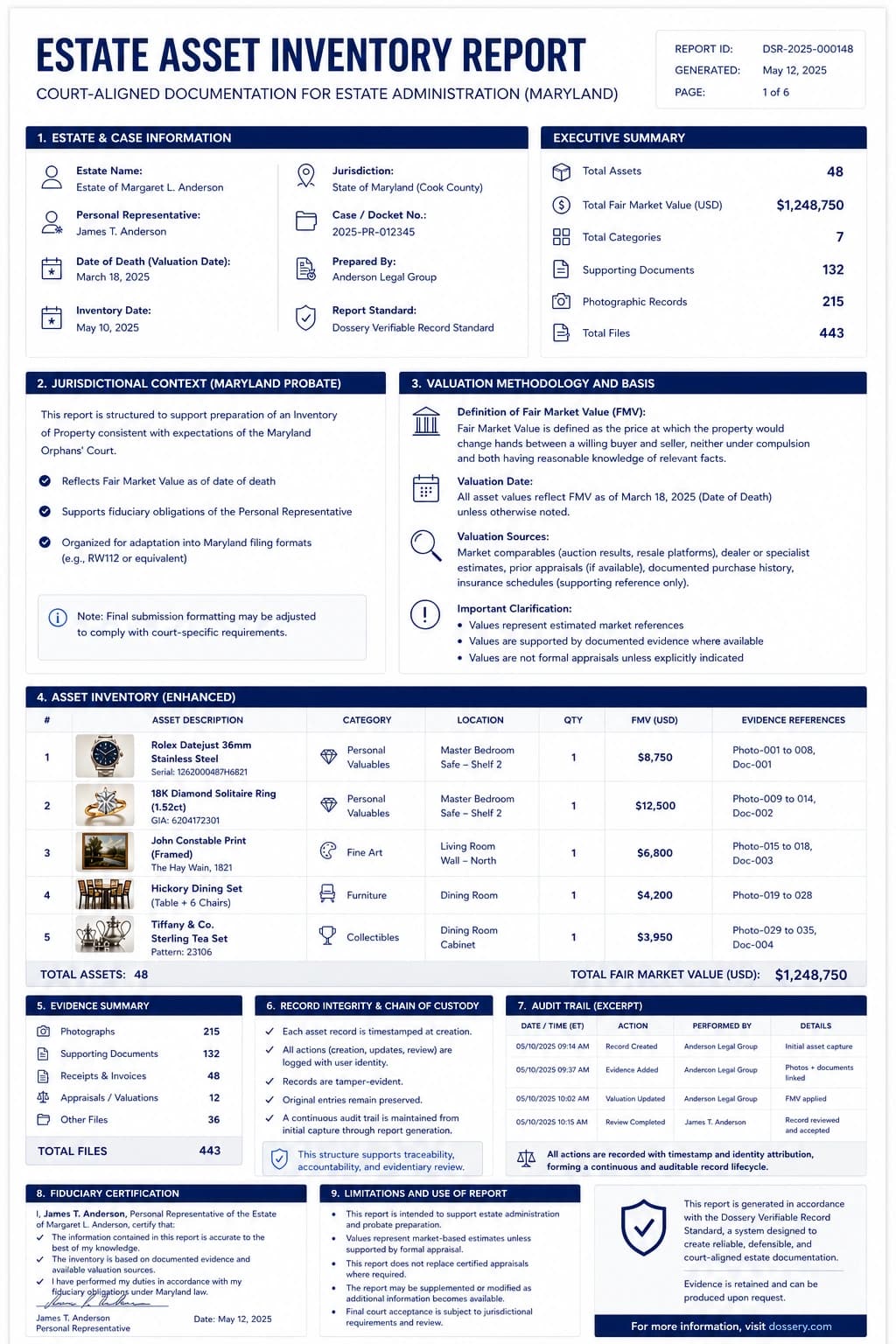
Actual reports reflect case-specific data and jurisdictional requirements.
Built for Your Role
For Attorneys
- Submit inventories formatted for legal use without reformatting
- Resolve disputes using timestamped records
- Reduce fiduciary exposure across matters
For Paralegals
- Organize documentation consistently across cases
- Eliminate reconciliation before filing
- Accelerate case preparation
For Fiduciaries
- Maintain a complete record of accountability
- Track every action and change per asset
- Reduce personal liability through clear documentation
Bring Structure to Estate Documentation
Capture once. Use throughout planning and probate.
Request access to discuss estate-focused use cases and early availability.