

The Problem
Asset Documentation Is Reconstructed Under Pressure
During probate, executors and attorneys must produce a complete inventory of physical assets, often without reliable records. Documentation is assembled from scattered sources, leading to inconsistency and risk.
- No single source of truth for asset records
- Incomplete or inconsistent documentation
- Manual reconciliation before every filing
In probate, documentation is created when accuracy matters most and errors carry legal consequences.
Replace Reconstruction with Recorded Evidence
Dossery supports two probate scenarios:
When records already exist: Asset records created during planning are reviewed, validated, and used directly. No reconstruction is needed.
When records must be created during probate: Executors capture asset details using guided fields. Records are sealed at creation and structured consistently, even under time pressure.
How Dossery Is Used in Probate
- Executors capture new asset details or validate records created during planning
- Supporting evidence is attached directly to each asset record
- Records are sealed and structured consistently regardless of when they are created
- Attorneys review complete records across the estate without reformatting
- Inventories formatted for legal use are generated directly from the system
Aligned with Estate Administration Workflows
Probate requires complete, consistent asset documentation to prepare filings and demonstrate fiduciary accountability.
- Prepare filings without reformatting asset data
- Review consistent records across all assets
- Reduce delays caused by incomplete documentation
What You File
Court-Ready Estate Inventory Report
Structured, auditable inventory documentation prepared from verified asset records.
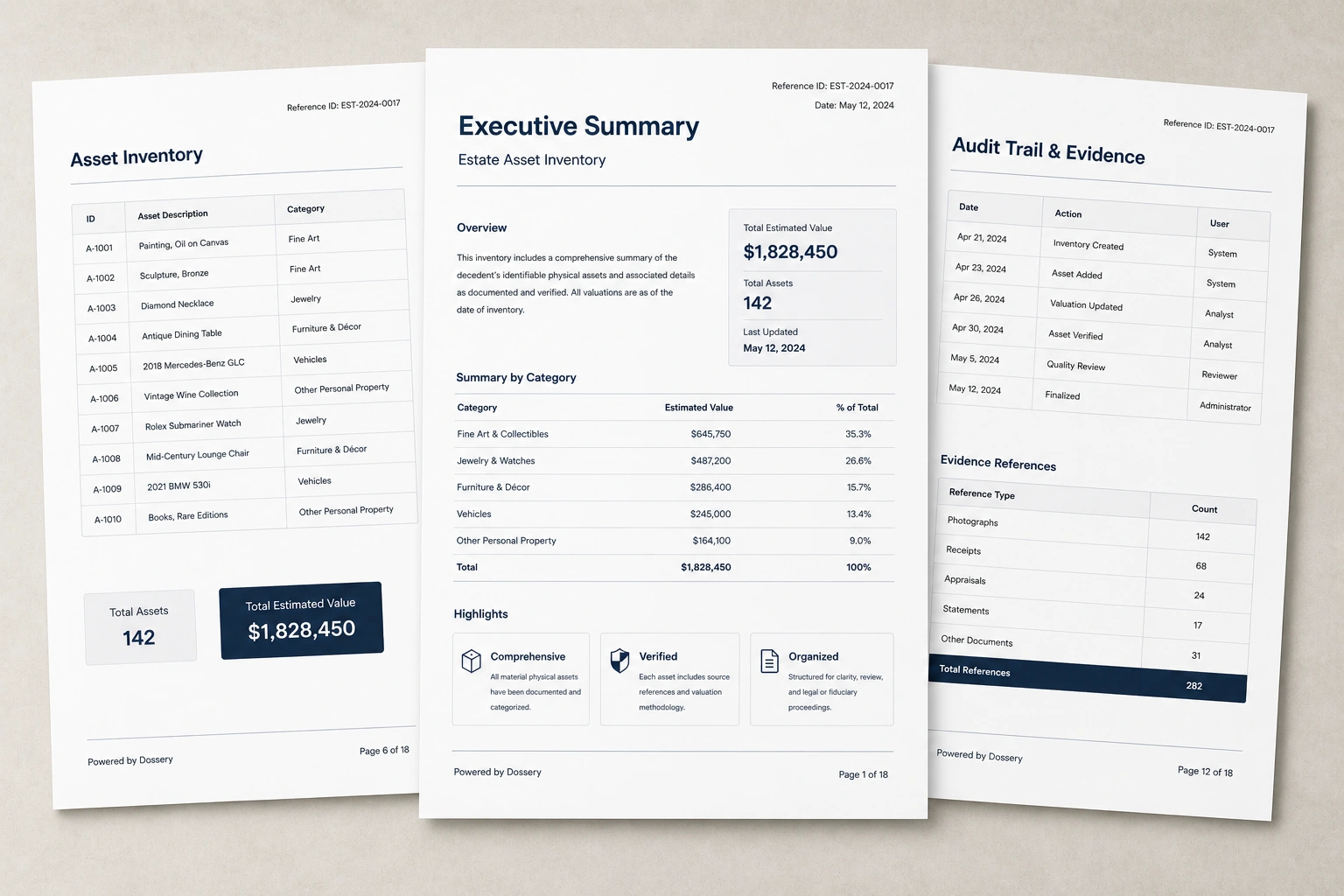
Representative probate output generated from structured asset records.
Jurisdiction-Specific Formatting
Reports are designed to support jurisdiction-specific formatting requirements as the platform expands.
Evidence-Linked Records
Photos, documents, valuation references, and supporting files remain attached to each asset.
Timestamped Audit Trail
Every record action is logged with time, identity attribution, and change history.
Fiduciary Accountability
Executors and fiduciaries can demonstrate how asset records were created, reviewed, and maintained.
Why This Supports Defensibility
The report is generated from structured records captured at the source, sealed at creation, linked to supporting evidence, and preserved with a continuous audit trail. This helps reduce ambiguity during probate review, fiduciary oversight, and contested estate scenarios.
Work from Verified Records During Probate
Eliminate manual reconstruction and generate inventories from structured asset data.
Where Defensibility Matters
- Probate filings require complete, accurate inventories
- Disputes depend on documentation of ownership and condition
- Fiduciaries must demonstrate accountability
- Courts rely on auditable records
Defensibility is determined by how records are created, not when they are needed.
Maintain Accountability Throughout Administration
Without a clear record, every decision carries risk.
- Track all documented assets in one system
- Maintain a complete record of activity and changes
- Reduce personal exposure through consistent documentation
What Improves During Probate
- Faster preparation of inventories
- Fewer disputes due to consistent records
- Clear documentation for fiduciary accountability
- Reduced time reconstructing asset information
Stronger When Records Exist in Advance
Probate is significantly more efficient when records already exist.
Records created during planning can be reviewed, validated, and used directly, without reconstruction.
This continuity transforms estate administration from a reactive process into a structured one.
What Happens After You Request Access
We confirm your role and use case
We review your estate documentation workflow
We share early access availability
We determine fit for planning or probate use
Bring Structure to Estate Administration
Eliminate reconstruction. Work from verified records.
Request access to discuss estate-focused use cases and early availability.